


UL 2560 vs. UL 1069: Comparing Safety Standards
UL 2560 vs UL 1069: Which Nurse Call Standard Does Your Facility Actually Need?
If you operate a senior living community or have the skilled nursing wing of one in 2026, there is a good chance you have encountered a compliance wall. Without proper insight into how a nurse call system can support both staff safety and consistency, and ensure the surveyor's happy with state or local surveys, then you may be complying with a standard that may be considered only as credible as the individual or agency that you are working with.
When discussing compliance with states, the confusion typically arises from the two numbers UL 1069 & UL 2560.
While these two numbers may appear to be similar in a specification sheet, choosing the wrong one can result in significant project overruns, or, quite possibly, you'll receive a failure to comply notice from your local or state surveyor this year. This is important; because understanding how the differences of these two standards will be helpful in ensuring that ensure proper implementation and cost savings associated with building construction or renovation.
The Core Difference: Acute vs Non-Acute Care
Understanding the context is crucial in applying these standards appropriately; you will need to determine what those responsible for producing the standards actually intended when they created them.
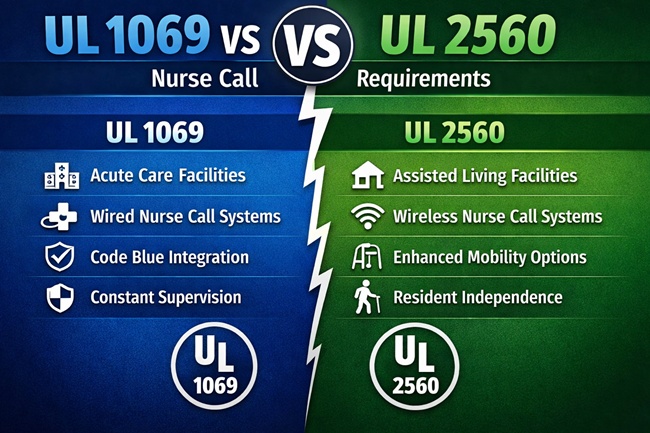
UL 1069 is a standard for the "hospital" environment; therefore, its design includes both acute care types of areas, such as emergency rooms and ICUs, where each second can mean the difference between life and death when dealing with telephones, thus dictating very strict and stringent regulations regarding equipment locations within a hospital-type environment. For example, there are regulations requiring devices constructed into walls and corridor dome lights adjacent to all patient rooms.
UL 2560 is a standard designed for the assisted living type of environment; it utilizes wireless pendants instead of physically attaching the residents to beds within a hospital-type environment, thus giving them access to the same types of resources that they would have in a home-like setting rather than having resources constructed from institutional-type materials.
Technical Face-Off: A Side-by-Side Comparison
|
Feature |
UL 1069 (Hospital) |
UL 2560 (Assisted Living) |
|
Primary Focus |
Speed & Reliable Hardware |
Movement Of Residents And Decor |
|
Corridor Lights |
Dome Lights Required On The Outside Of Each Room |
No Dome Lights Required. Alerts Are Sent To All Stations/To Mobile Devices |
|
Backup Power |
Optional Dome Lights (Usually At An Entire Facility) |
Dome Light Back-Up Integrated System Required. |
|
Fault Notification |
90 Second System Failure Notification |
24 Hour Check-In for Wireless (Mobile) Devices |
|
Device Type |
The majority of the wall stations are fixed |
Fixed Wall Stations are fixed and mobile, which have a mix |
|
Oxygen Safety |
Engineered to work in an oxygen-rich environment |
Not Specifically Required |
The "Mixed-Use" Dilemma: The Biggest Headache of 2026
More and more, you hear about this newer "Campus Continuum" model - where multiple levels of care (including both Assisted Living and Skilled Nursing (SNF)) are provided within the same physical location.
The "trap": Many administrators incorrectly assume that just putting a UL 2560 wireless system in the entire facility will be sufficient, which is inaccurate; most states still require UL 1069 systems be installed on all beds that provide care in a licensed skilled nursing facility.
If your facility is mixed-use, you really only have two options:
A "Split" System - utilizing two separate platforms (one per wing).
An "Over-Spec Move" - putting in a wireless system that is currently compliant with UL 1069. Yes, they do exist, but they are significantly more expensive due to the additional testing required for compliance with hospital standards related to drop and interference testing.
Why "Wireless" doesn't always mean "UL 2560"
It is a well-known misconception that all wireless systems are classified as UL2560. However, many of the most advanced wireless systems in use today have been classified as being under UL1069.
If you operate in a state where installed wiring codes are very restrictive (generally speaking, states such as Florida and Texas), then you may have to utilize a UL1069 wireless system for compliance purposes. While these systems provide the no-construction benefit of being a wireless device, they also fulfil the requirements set forth by state inspectors in skilled nursing facilities regarding hospital-grade durability.
Summary: Which one do you buy?
Purchase a UL2560 system if: You are an Assisted Living Facility or an Independent Living Facility and want a discreet pendant-style system that will not make your facility look like a hospital.
Purchase a UL1069 if you are a Skilled Nursing Facility, Critical Access Hospital, or any other facility where "Code Blue' or acute medical responses occur on a regular basis.
The Bottom Line: Do not allow any vendor to sell you a system based on supposed "features" until you verify that the system meets the licensing requirements of your state for your specific bed count.
What’s Next?
Once you are aware of your required standard, your next challenge will be finding out how much it will cost. [Read our Guide on Wired vs Wireless ROI (Page 5)] to determine how much money you'll save if you don't have to install a hard-wired system in your next retrofit.
Related Expert Resources
Compliance & Standards
Main Nurse Call Systems Overview - A foundation for understanding how different architectures meet state codes.
Emergency Call System Design - How to plan a layout that meets the specific legal needs of your facility type.
System Versatility
Benefits of Hybrid Systems - The ideal way to manage a campus with multiple levels of care.
Designing Home-Like Environments in Memory Care - How to meet AL requirements while maintaining a residential feel.
Next Steps & Product Links
Ensure Compliance: Shop UL-Listed Nurse Call Hardware - Browse our catalog of stations and pendants certified for AL and SNF environments.
Regulatory Consultation: Request a Compliance Review - Not sure which standard applies to you? Let our experts help you choose a system that meets your state's specific requirements.
Organizations We Work With
