ROI: Wireless vs. Wired Nurse Call Systems
ROI: Wireless vs. Wired Nurse Call Systems
When determining how to evaluate the return on investment from a nurse call system, the fundamental aspect of whether you choose a wired infrastructure or a wireless infrastructure is the biggest variable when it comes to calculating your overall cost of ownership. For decades, traditional wired nurse call systems have been the industry standard, but due to the advancements of wireless and hybrid systems in recent years, nursing facilities now have an alternate financing route to achieve a return on their investment sooner than previously, through reduced installation labor and increased operational flexibility.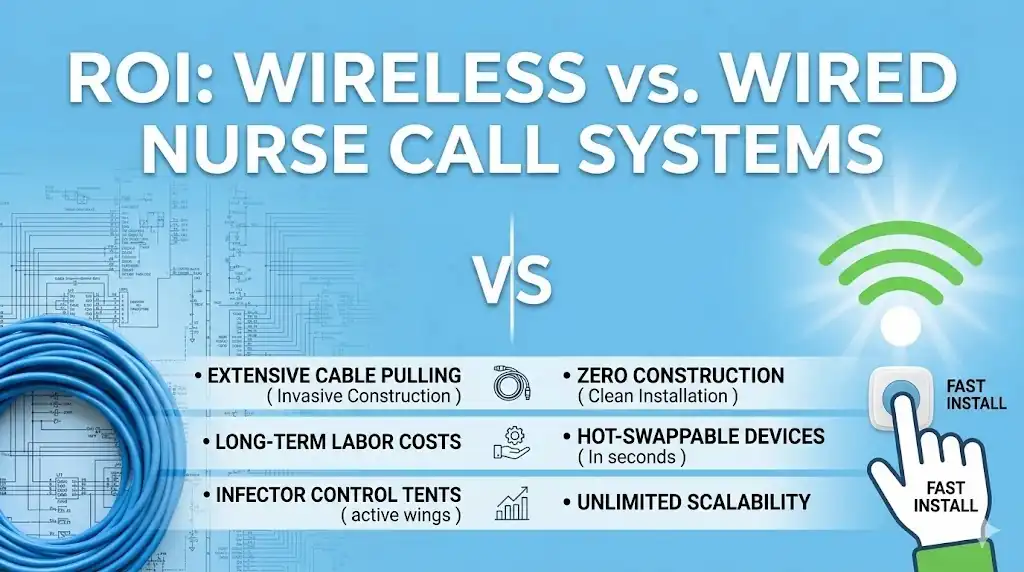
Installation Costs - Capital Costs vs Operating Costs
The most immediate cost that will have on your return on investment is the "hidden" costs associated with the installation.
- Wired Nurse Call Systems: Require extensive conduit and back-box installations, along with specialized labour for pulling miles of copper wire through walls. Many nursing facilities must also provide expensive temporary Infection Control "tents" within the active wings where they are constructing the system to minimise the potential for infections to occur in these active areas of the facility.
- Wireless Nurse Call Systems: Remove the invasive construction of conduit and back-boxes, resulting in "Clean" installations with an installation time measured in days instead of weeks, dramatically reducing initial capital costs.
Long-Term Operational Savings
A true return on investment calculation for a nurse call system must look beyond the initial check and look at the daily efficiencies gained by staff.
- Maintenance: Wireless Nurse Call Systems allow staff to perform simple and efficient "Hot-swap" of devices while on duty. If a button breaks on a wireless nurse call system, a staff member can have a new button synchronised to the nurse call system within seconds without having to call an expensive third-party technician to trace the broken wire.
- Scalability: A major benefit of a wireless system is its scalability. If you want to add a bed or convert a common area into a patient care area, there is virtually no expense to set up in a wireless environment, while adding to a hard-wired system will require a new "pull" (cabling) and hardware integration, both of which are costly processes.
Hybrid (Wi-Fi & Hard Wired) Compromise
For most facilities, the most effective nurse call ROI will be between the two extremes. A hybrid system allows you to leverage the existing wiring that you currently have, while simultaneously adding wireless components to your new wings or mobile resident pendants. This will provide for a continued return on the old system's investment, while at the same time, updating to technology standards.
Additional Resources for Your Reference
- An Overview of Nurse Call Systems - Overview of the primary differences and characteristics of the systems.
- Analog to Modern Systems - Tips on how to migrate from legacy hardware to modern technology.
- Emergency Calling System Design - How to create an optimal design for your facility to ensure life safety at the lowest cost.
Next Steps
- Compare Hardware Options - Review Unit Prices of Wireless and Wired Components. This will help in developing your project budget.
Organizations We Work With