


Nurse Call System RFP Checklist for Hospitals, Nursing Homes, and Assisted Living Facilities
If we talk about a sold nurse call system RFP, it should do far more than list buttons, pull cords, and corridor lights. What exactly it does is to convert clinical workflows into testable requirements while covering different aspects like call priorities, system resilience, regulatory compliance, integrations, cybersecurity, installation, training, support, costs, and more.
Miss one of those layers? Bids are difficult to compare. Worse, the facility may receive a technically compliant system that is not according to how its staff actually works.
Therefore, if you are operating a hospital, nursing home, or assisted living facility and want to avoid that trap, please continue reading this nurse call system RFP checklist.
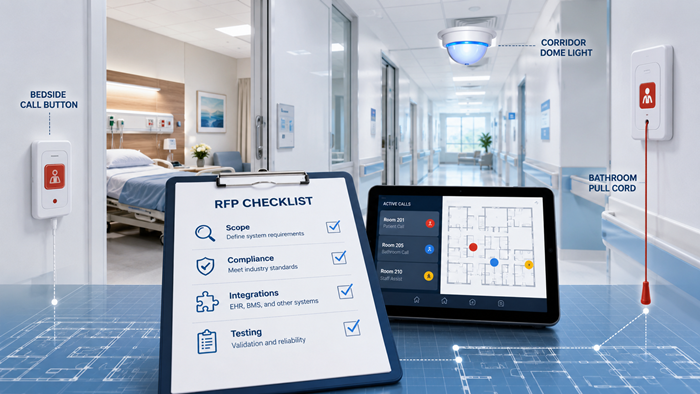
Nurse Call System RFP Checklist: Define the Project Scope First
You should start with the building and not with the product brochure.
Identify the project type
State whether the work involves:
New construction
Full system replacement
Expansion of an existing platform
A phased retrofit in an occupied facility
Integration with retained legacy equipment
Let’s add some more to renovations. You should describe which floors must remain operational, when shutdowns may occur, as well as whether or not temporary call coverage is required. Apart from that, you may ask bidders to disclose any assumptions about reusable cabling, pathways, power circuits, network switches, servers, and work by other trades.
Create a room and device schedule
Inventory every patient or resident location, bathroom, shower, treatment room, common area, staff station, corridor, outdoor zone, and specialty department. After that, you can assign the appropriate device type and configuration that is required for each individual space.
This schedule is the project’s quantity baseline. Without it, one bidder may price 80 bathroom stations while another 110. The surprising thing is that both proposals can appear “complete.”
Core Nurse Call System Requirements to Include
The functional section should describe what happens from the moment when someone places a call until a caregiver receives the call, responds, and clears the event.
Define each call workflow
A call matrix is key. Make it for routine calls, bathroom emergencies, staff assist requests, clinical codes, bed-exit alarms, equipment alerts, system faults, resident check-ins, and wander events. The following tables highlights what you may specify for every event:
Cancellation rules are important. A high-priority call that can be cleared remotely may conceal whether staff reached the originating room. As an example, the federal UFGS nurse call specification uses a four-level priority structure and calls for certain higher-priority events to be canceled only at the initiating station. Use it as a design model and tweak as per facility policies.
Specify devices by function
First of all, you should understand that nurse call system requirements depend on the care setting. Still, they may cover patient stations, pillow speakers, accessible call cords, squeeze bulbs, breath-activated devices, wet-location pull stations, code buttons, staff-presence controls, corridor lights, duty stations, consoles, mobile handsets, as well as behavioral-health hardware.
Never accept “or even equivalent” without measurable equivalency criteria. You should ask for model numbers, listing information, mounting details, environmental ratings, cleaning compatibility, expected battery life, supervision method, and replacement availability.
Quantify resilience and capacity
Suppose a controller, server, network link, power source, or integration fails. What must still be working? The request for proposal should this factor. But you should not stop here and ask vendors to elaborate on fault isolation, device supervision, redundant components, offline call routing, backup power, time synchronization, and recovery procedures.
The US population aged 65 and older reached 61.2 million in 2024 after growing 3.1% in one year. So, specifying expansion capacity beyond the facility’s current bed count is important.
Along these lines, the UFGS specification offers some of the relevant owner-selectable benchmarks. These are simultaneous processing of calls, electronic supervision of devices and wiring, a dedicated network for fundamental nurse call operation, 15 minutes of full-power backup, and capacity for 25% future station expansion. Are these figures universal mandates? Not really. But they are far more beneficial than vague language such as “adequate capacity.”
Hospital Nurse Call System Specifications and Compliance Standards
Do you also dump codes into a sentence and then forget? That’s not a good practice.
What you have to do is to make a project-specific compliance matrix.
Identify the correct system standard
UL separates two major applications:
UL 1069: traditional hospital signaling and nurse call equipment.
UL 2560: emergency call systems for assisted and independent living facilities.
UL values the full system arrangement, such as interoperability and resistance to interference, and doesn’t take an isolated button as proof that the installed configuration complies.
What can the design team do here? Well, it should review the adopted editions of NFPA 99, FGI Guidelines, electrical regulations, state healthcare licensing provisions, accessibility requirements, and any local amendments. Adoption differs from jurisdiction to jurisdiction. FGI explicitly recognizes the authority having jurisdiction as the final arbiter of applicability.
You should request documentary evidence for each claim:
Certification or listing number
Covered equipment models
Applicable standard and edition
Unlisted third-party interfaces
Proposed substitutions
Responsibility for inspections and approvals
Even small wording changes have some sort of significance. As an instance, an FGI clarification to the 2022 Hospital Guidelines says that visible nurse call signals are required at the patient-room corridor door as well as nurse/control station but not at every duty station.
Architecture, Integrations, Cybersecurity, and Data Ownership
We believe that architecture should follow risk and workflow. Not fashion.
A hardwired platform may be appropriate for high-acuity environments that require fixed devices and deterministic infrastructure. On the other hand, wireless technology might lower construction disruption and support roaming pendants. Then come hybrid designs that make sense whenever a facility needs permanent room stations along with campus-wide mobility.
You should make it mandatory for bidders to provide documentation on radio coverage assumptions, frequency utilization, interference testing, battery supervision, network dependencies, cabling topology, bandwidth, server placement, and single points of failure.
List integrations one by one
Interfaces may include:
Staff smartphones or dedicated handsets
Paging and VoIP
ADT and electronic health records
RTLS
Bed-exit monitoring
Access control and wander management
Infant protection
Room lighting and television
Reporting and staff-assignment software
For each of the interfaces mentioned above, you will have to identify the data exchanged, responsible vendor, protocol, license, middleware, failure behavior, testing method, and support boundary. Here, we would like to mention the warning from the UFGS. That is, integrations increase both cost and cybersecurity complexity, as well as it also calls for maintaining the fundamental system’s listing when middleware or supplemental platforms are implemented.
Put cybersecurity terms in the bid
Not only that, but you must also ask for network diagrams, ports and protocols, role-based permissions, encryption, patch procedures, vulnerability alerts and notifications, audit logs, backups, software support dates, and secure remote-access controls.
In 2023, breaches that impacted at least 500 people in the health care sector also affected more than 167 million people. Reported breaches increased 102% from 2018 to 2023.
HHS has something to say here. Its healthcare cybersecurity goals recommend multifactor authentication and network segmentation. HHS also advises to restrict remote access to operational and connected medical tech through encrypted connections combined with MFA.
The contract should also settle data ownership. Can the facility export its call records in a usable format? Will reporting survive a vendor change? Who holds admin credentials?
Those details are considerable because they influence whether the system becomes an owned asset or turns into a subscription-bound dependency in a quiet manner.
Facility-Specific RFP Addenda
Don’t copy specifications! One won’t be applicable to every care environment.
Hospitals
Generally speaking, hospital projects need differentiated clinical priorities, code workflows, departmental zoning, redundant annunciation, medical-device interfaces, infection-control coordination, and migration from the old platform that is planned very carefully.
Each year, between 700,000 and 1 million patients fall in the hospitals of the United States, according to the AHRQ. And almost one-third of hospital falls are preventable.
Meanwhile, behavioral-health areas might demand tamper-resistant devices, decreased ligature risk, specialized mounting, and different call-initiation methodologies.
Nursing homes
According to federal regulations, nursing facilities must be able to provide a communication system that relays resident calls from each bedside as well as from toilet and bathing facilities to a staff member or centralized staff work area. The RFP must therefore define how that minimum obligation operates in practice during overnight staffing, mobile routing, and escalation.
We suggest you include resident-accessible controls, bathroom coverage, staff assignment, call-history reporting, wander interfaces, and straightforward replacement procedures.
Assisted living facilities
Assisted living specs are more tended to portable pendants, apartment identification, resident check-in, door monitoring, campus coverage, outdoor call locations, and supervised batteries. Remember, you should know very early whether UL 2560 applies to the proposed configuration and ask the bidder to identify any devices that are excluded from the certified system.
Supplier Expertise, Installation Flexibility, and Five-Year TCO
A nurse call project may not require one company that supplies, installs, commissions, and services the entire system. It is possible that a facility buys equipment and system-design guidance from a national supplier and assigns field installation to its own IT department, low-voltage integrator, electrical contractor, in-house maintenance team, or an installation partner.
Evaluating the equipment supplier? You should never forget to request manufacturer authorization, relevant nurse call experience, product-selection expertise, accurate equipment schedules, integration knowledge, technical documentation, warranty terms, parts availability, software-support dates, as well as access to knowledgeable technical guidance.
Installation present in the same proposal? Evaluate installer licensing, comparable field projects, commissioning capability, project staffing, and on-site response commitments as a separate workstream. Installation procured independently? Place those requirements in the installer or integrator scope, and you should not use them to score the equipment supplier.
In order to compare the total cost of ownership over a five-year period, ask for a line-item price schedule and who is responsible for each of the costs. Equipment, design, labor, cabling, gateways, servers, software, integrations, cloud/cellular fees, batteries, training, preventive maintenance, updates, warranties, and optional items must be included.
The facility can add together those amounts during the bid evaluation process without having to put the supplier and installer into a single business model. This kind of approach uncovers the total lifecycle cost as well as keep the owner free in his choice of how to implement the system.
Installation, Commissioning, and Acceptance Tests
The RFP should specify who is going to do what for the implementation rather than expecting the equipment supplier to do the field installation as well.
Tasks, like surveys, shop drawings, riser diagrams, cable schedules, room numbering, permits, infection control, temporary protection, device labeling, legacy system removal, network configuration, and site coordination, can be split. But it depends on the procurement model.
And the next step is to make acceptance objective.
Federal UFGS model links final system acceptance to 30 days of trouble-free operation.
Test every initiating device. Verify priority, annunciation, routing, escalation, cancellation, corridor indication, event logging, staff assignment, and interface behavior. Repeat selected tests during a network outage, controller fault, and normal-power failure. Wireless systems? Test every occupied room, stairwell, elevator lobby, exterior area, and known coverage edge.
In view of that, the BEC nurse call system RFP checklist includes factory test results, O&M manuals, warranty documentation, point-to-point records, battery checks, processor diagnostics, power-supply verification, as well as field-device inspection. Those categories appear to be a great base in order to build a project-specific acceptance form.
If we talk about closeout responsibilities, these should be broken up in the same way. The equipment supplier or manufacturer can offer configuration files, software documentation, administrator credentials, warranty records, product manuals, and training of the system. On the other hand, as-built drawings, cable testing records, device labels, commissioning results, field corrections, and installation warranties may be the responsibility of the installer or integrator.
The RFP should request the following closeout items from each producer:
Approved as-built drawings
Configuration and database backups
Administrator credentials
Test and deficiency reports
Asset and spare-parts lists
Training records
Warranty and support documents
The UFGS model calls for at least two user-training sessions, two maintenance-training sessions, and refresher instruction around month 11. The RFP should also classify whether each session will be delivered by the equipment supplier, manufacturer, installer, integrator, or facility team.
Example Nurse Call RFP Bid Evaluation Scorecard
Price alone is not that capable and produces a distorted comparison.
However, a weighted scorecard is fairer:
Keep in mind that the above percentages are not hard numbers. Facilities can adjust them so that they are according to the acuity, staffing model, renovation risk, and internal IT capability.
If equipment is being supplied and installed separately, please use a different scorecard to assess equipment installer based on licensing, site staffing, construction scheduling, equipment commissioning, warranties in the field, and response commitments. An equipment supplier should not lose points just because the facility picks another qualified installation partner.
Four Questions to Resolve Before Releasing the RFP
Does the certification cover the complete proposed configuration?
No need to request a certificate for a single component. But you should request evidence that covers controllers, stations, annunciators, wireless devices, gateways, and software itself.
What remains operational during a failure?
The important thing is that the answer should differentiate between core call handling and mobile notifications, reporting, integrations, and remote access mechanisms.
Which interfaces require recurring licenses or middleware?
Get every dependency and renewal cost into the bid form before proposals arrive.
How are post-installation responsibilities divided?
Identify which party will deal with product questions, warranty claims, software updates, replacement parts, remote guidance, on-site troubleshooting, and emergency field service.
Make an RFP That Produces Comparable and Defensible Bids
Suppose a nurse call RFP is well-written. Every bidder gets the same rooms, workflows, technical boundaries, testing standards, and cost assumptions. This way, an ambiguous technology purchase gets converted into a controlled clinical infrastructure project.
We are a national distributor at BEC Integrated Solutions and we are here to help hospitals, nursing homes, and assisted living facilities evaluate wired and wireless options, pick suitable products, develop equipment schedules, and obtain knowledgeable technical guidance. Facilities are free to complete installation through their own IT department, in-house maintenance team, low-voltage integrator, electrical contractor, or preferred installation partner.
Organizations We Work With
